

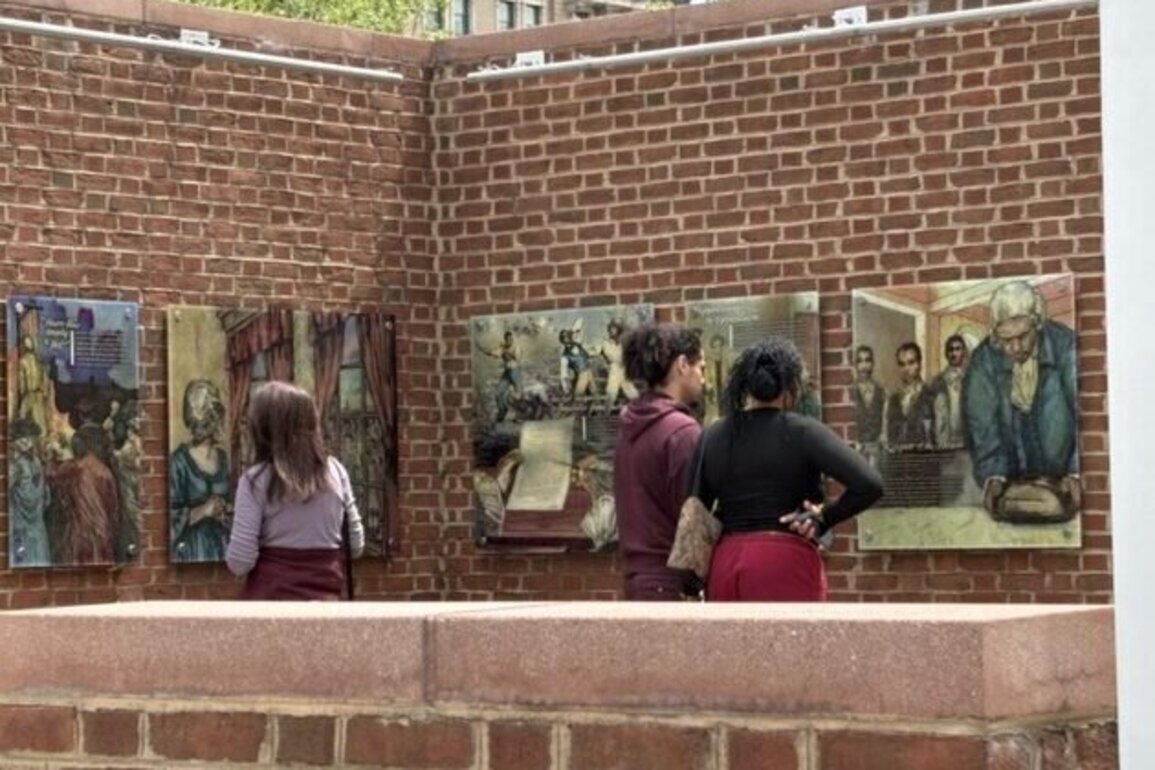
PHILADELPHIA (CN) - The city of Philadelphia again butted heads with the Trump administration on Tuesday, arguing in the Third Circuit that the Interior Department had no right to dismantle an exhibit on the nine people enslaved by George Washington in his Philadelphia home.
The National Park Service began dismantling the exhibit - located at the President's House site, across from Independence Hall - on Jan. 22, prying informational panels off the walls and shutting off video presentations.
Within hours, Philadelphia sued the agency and Interior Department, arguing the federal government's failure to consult with and receive approval from the city before removing the exhibit violated the Administrative Procedure Act.
Making their case in Philadelphia federal court, the city cited two documents: a 2006 deal between the city and National Park Service that created the President's House site and slavery exhibit, and the 1950 congressional agreement that established mutual stewardship of the historic district surrounding Independence Hall between the city and National Park Service.
Those two documents, the city argued, ensure that the federal government cannot alter the President's House site without city approval, even though the site is owned by the National Park Service.
On Feb. 16 - President's Day - U.S. District Judge Cynthia M. Rufe, a George W. Bush appointee, ruled in the city's favor, ordering full restoration of the exhibit and comparing the Trump administration's actions to those of the Ingsoc party in George Orwell's novel, "1984."
The Interior Department promptly appealed.
Representing the Interior Department in the Third Circuit, Assistant U.S. Attorney Gregory in den Berken described the lower court's order as "sweeping" and framed Rufe's mandate as granting the city "veto power over what the federal government says on its own property." He argued the removals constituted "curational decisions" rather than agency actions - a distinction that immediately drew questions from the appeals panel.
"The city's position seems to be that what's going on here is not curation, but elimination," said U.S. Circuit Judge Thomas M. Hardiman, a George W. Bush appointee. "Is the federal government's position that you have the power to eradicate all statements or acknowledgement of slavery at the President's House?"
The attorney replied asserting the federal government's right to emphasize what it chooses before Hardiman again assumed control of the discussion.
"I'm not talking emphasis," he told in den Berken. "I'm asking whether the federal government has the power to eliminate."
"Any reference to slavery at the President's House site? Yes, I think inherent in the curational decision is the ability to make that decision if they thought it appropriate," in den Berken answered, later clarifying that altering the site's structures themselves could create a cognizable harm.
Shifting focus to foundational documents, in den Berken argued that both the city and lower court misinterpreted the 1948 congressional act preserving a site surrounding Independence Hall.
That act only granted Philadelphia land rights to an area of three blocks, excluding land on which the President's House exhibit stood, in den Berken argued. The city claims its rights extend to the entire 55-acre Independence National Historic Park as it stands today, which would grant it mutual stewardship of the exhibit site.
"There is no reason - no logical, sensible reason - that Congress, when it drafted this statute, would have intended for the city over time to gain more expansive authority over federal property," in den Berken told the appeals panel.
However, Hardiman again countered the attorney, suggesting a "fuzzier" 1950 congressional agreement regarding land stewardship might provide the city more expansive rights.
"The 1950 act seems to express some forward-looking intent that the park would expand over time, and that the federal government and the city of Philadelphia would act cooperatively as that park expanded," Hardiman said. "Isn't that right?"
Still, in den Berken disagreed, suggesting the 1950 act anticipated the park's expansion without expanding the city's right over that added land.
Representing the city of Philadelphia, attorney Anne Taylor insisted the Interior Department's removal of the exhibits constituted an agency action via sanction, describing the removal as a destruction of property.
"Here, the property is the President's House, and the destruction is the removal of all the panels that give the President's House meaning," Taylor said.
And while the Interior Department has since presented proposed replacement panels for the exhibit, Taylor noted nothing on the record implied the federal government was contemplating any action beyond removing the initial exhibits. However, when pressed by U.S. Circuit Judge L. Felipe Restrepo - a Joe Biden appointee - Taylor ceded that such information could likely be considered if the case were remanded.
Later, the three-judge panel questioned what ongoing rights the city holds following its full transfer of ownership of the President's House site to the federal government.
"All of the work that the city did, and the public taxpayer dollars that the city spent, was to create ... a permanent outdoor installation," Taylor said, suggesting the removal of exhibit panels fundamentally contradicts a residual interest held by the city.
Hardiman pushed back on this notion, however, noting that language implying permanence does not exist in any contractually binding document on the record.
Taylor argued it ultimately may not matter whether the documents underpinning the site grant the city contractually enforceable rights - if the Interior Department failed to take those documents into account before removing the exhibit, that in and of itself could establish a constitutional violation.
Calling in remotely via video call, U.S. Circuit Judge Peter J. Phipps - a Donald Trump appointee - rounded out the appeals panel.
Source: Courthouse News Service